
Let me now guide you along the left aisle, where art and devotion come together in remarkable forms.
This chapel is dedicated to Saint Cajetan of Thiene, whose gilded wooden statue is preserved here in the church. It is a work commissioned by the Company of Mercy in 1777. The statue has not always been here to offer comfort to the faithful: for almost two centuries, it was carefully preserved in the Church of San Giovanni, and only in 1970 was it permanently transferred to this Cathedral.
However, the bond between Poggio Mirteto and the saint goes back even further. As early as 1698, a small gilded image of the saint arrived from Naples, from the Church of San Paolo Maggiore. It was a gift from Father Giovanni Battista Cagiano and contains a fragment of the saint’s cope, marking the beginning of the feast dedicated to him.
But who was this saint? Cajetan of Thiene was born in Vicenza in 1480 into a noble family. He became a priest and devoted his entire life to the spiritual reform of the clergy and to caring for the sick and those most in need. In 1524, in Rome, he founded the Order of Clerics Regular, known as the Theatines, together with Gian Pietro Carafa, the future Pope Paul IV. The members of the order took a vow of absolute poverty and chose not to beg, placing themselves entirely and exclusively in the hands of Divine Providence.
After moving to Naples, Cajetan distinguished himself through his tireless charity during the epidemics and social tensions that afflicted the city. He died there in 1547, exhausted by his labours and his love for his fellow human beings. He was later universally venerated as the “saint of Divine Providence.”
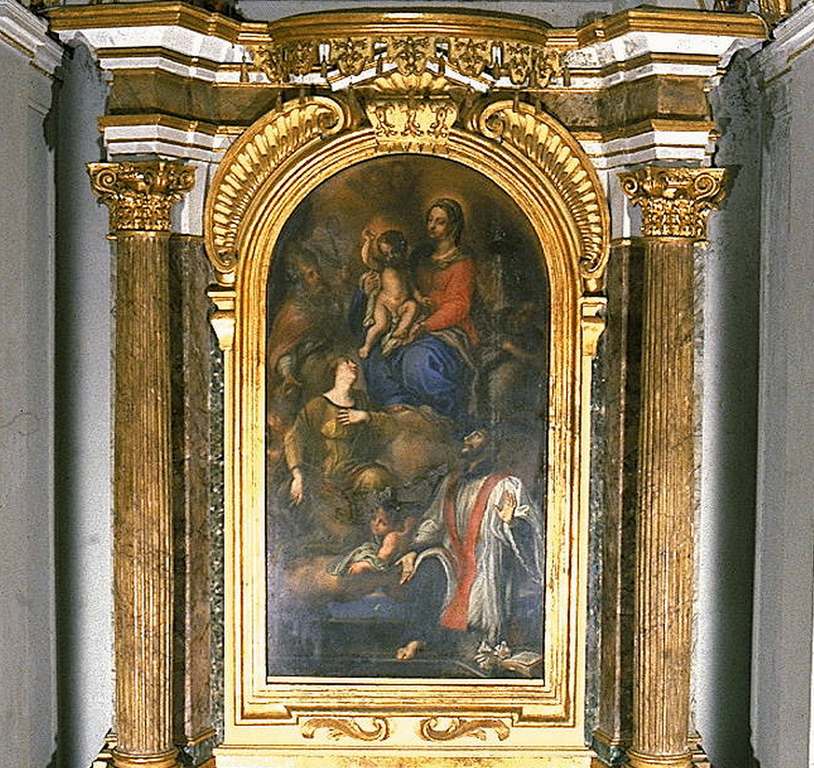
As we move towards the altar, you can admire a painting depicting Saint Cajetan of Thiene and Saint Lucy. The decoration of the chapel was commissioned by the Perrini family in 1688.
Take a moment to contemplate the stucco decorations that adorn the vault and the pendentives. Within the pediment above the altar, between two angels, you can make out the figure of Saint Cajetan. In the pendentives, you will see the four Evangelists, each accompanied by his traditional symbol.
At the centre of the dome is a depiction of the Exaltation of the Name of Jesus. Above the opening connecting this chapel with the Chapel of Saint Innocent, you can admire the apparition of the Virgin and Child to Saint Cajetan.
